
-
×
 Takedowns with Garry St. Leger
1 × 6,00 $
Takedowns with Garry St. Leger
1 × 6,00 $ -
×
 The Iodine Crisis: What You Don’t Know About Iodine Can Wreck Your Life (PDF+Mp3) with Lynne Farrow
1 × 6,00 $
The Iodine Crisis: What You Don’t Know About Iodine Can Wreck Your Life (PDF+Mp3) with Lynne Farrow
1 × 6,00 $ -
×
 Affiliate Marketing On Crack with Benjamin Fletcher
1 × 5,00 $
Affiliate Marketing On Crack with Benjamin Fletcher
1 × 5,00 $ -
×
 SEDUCE YOUR EX: Get Your Ex Back + How to Date: Build a Relationship, Stay In Love + Get Fit To Get Dating: How to Meet Your Dream Woman
1 × 5,00 $
SEDUCE YOUR EX: Get Your Ex Back + How to Date: Build a Relationship, Stay In Love + Get Fit To Get Dating: How to Meet Your Dream Woman
1 × 5,00 $ -
×
 AI Email Academy And Advertorial Mastery with Zarak
1 × 27,00 $
AI Email Academy And Advertorial Mastery with Zarak
1 × 27,00 $ -
×
 The Lost Art of Closing with Anthony Iannarino
1 × 5,00 $
The Lost Art of Closing with Anthony Iannarino
1 × 5,00 $ -
×
 Wealth Bootcamp with Hypnosis Bootcamp
1 × 39,00 $
Wealth Bootcamp with Hypnosis Bootcamp
1 × 39,00 $ -
×
 The Teasing Method - Tease Her Until She Explodes: The Ultimate Guide to Going Down on a Woman by John S
1 × 5,00 $
The Teasing Method - Tease Her Until She Explodes: The Ultimate Guide to Going Down on a Woman by John S
1 × 5,00 $ -
×
 The Blueprint Training 2020 with Ryan Stewart
1 × 5,00 $
The Blueprint Training 2020 with Ryan Stewart
1 × 5,00 $ -
×
 SSL Sniper with Tom Gaddis and Nick Ponte
1 × 5,00 $
SSL Sniper with Tom Gaddis and Nick Ponte
1 × 5,00 $ -
×
 Facebook Ads for ecommerce with Susan Wenograd
1 × 39,00 $
Facebook Ads for ecommerce with Susan Wenograd
1 × 39,00 $ -
×
 Courageous Coaching Certification with Kendall SummerHawk
1 × 54,00 $
Courageous Coaching Certification with Kendall SummerHawk
1 × 54,00 $ -
×
 7-STEP VIDEO TOOLKIT - SIDEHUSTLE NINJA PRO
1 × 5,00 $
7-STEP VIDEO TOOLKIT - SIDEHUSTLE NINJA PRO
1 × 5,00 $ -
×
 Automated Income Assets with Benjamin Fletcher
1 × 5,00 $
Automated Income Assets with Benjamin Fletcher
1 × 5,00 $ -
×
 Traffic Stream with Fergal Downes
1 × 5,00 $
Traffic Stream with Fergal Downes
1 × 5,00 $ -
×
 Jewelry Making, Learn How To Create Brooch, Bead Embroidery
1 × 5,00 $
Jewelry Making, Learn How To Create Brooch, Bead Embroidery
1 × 5,00 $ -
×
 Email Marketing Masterclass with Mick Meaney
1 × 5,00 $
Email Marketing Masterclass with Mick Meaney
1 × 5,00 $ -
×
 Psychedelic-Assisted Psychotherapies: A Policy Perspective with Victor Cabral - PESI
1 × 15,00 $
Psychedelic-Assisted Psychotherapies: A Policy Perspective with Victor Cabral - PESI
1 × 15,00 $ -
×
 Precision Nutrition - How to Fix a Broken Diet + Intermittent Fasting - John Berardi
1 × 5,00 $
Precision Nutrition - How to Fix a Broken Diet + Intermittent Fasting - John Berardi
1 × 5,00 $ -
×
 Systems Health Care Next Level - Series 4 By Stephen Gangemi - Systems Health Care
1 × 93,00 $
Systems Health Care Next Level - Series 4 By Stephen Gangemi - Systems Health Care
1 × 93,00 $ -
×
 ATTRACTION MASTERY Course with Mystery and Beckster
1 × 194,00 $
ATTRACTION MASTERY Course with Mystery and Beckster
1 × 194,00 $ -
×
 A Biopsychosocial Approach to Clinical Practice with The Knowledge Exchange
1 × 148,00 $
A Biopsychosocial Approach to Clinical Practice with The Knowledge Exchange
1 × 148,00 $ -
×
 Recycle Your Art with Andrea Chebeleu
1 × 5,00 $
Recycle Your Art with Andrea Chebeleu
1 × 5,00 $ -
×
 SEO That Works 4.0 with Brian Dean
1 × 5,00 $
SEO That Works 4.0 with Brian Dean
1 × 5,00 $ -
×
 Blocking & Lighting A-Z with Shane Hurlbut
1 × 8,00 $
Blocking & Lighting A-Z with Shane Hurlbut
1 × 8,00 $ -
×
 Bestseller In A Day Workshop with Amanda Craven
1 × 5,00 $
Bestseller In A Day Workshop with Amanda Craven
1 × 5,00 $ -
×
 Roleta Guard with Leandro Slaib
1 × 6,00 $
Roleta Guard with Leandro Slaib
1 × 6,00 $ -
×
 Warrior Shred with Angela Gargano
1 × 6,00 $
Warrior Shred with Angela Gargano
1 × 6,00 $ -
×
 Freelance 101 Academy 2021 - Saheli Chatterjee
1 × 5,00 $
Freelance 101 Academy 2021 - Saheli Chatterjee
1 × 5,00 $ -
×
 Make Compelling Videos That Go Viral - Marques Brownlee
1 × 6,00 $
Make Compelling Videos That Go Viral - Marques Brownlee
1 × 6,00 $ -
×
 Compounding Growth Mastery Elite with Simpler Trading
1 × 5,00 $
Compounding Growth Mastery Elite with Simpler Trading
1 × 5,00 $ -
×
 Golden Leads: How I Get High-paying Clients With Social Media with Jose Rosado
1 × 23,00 $
Golden Leads: How I Get High-paying Clients With Social Media with Jose Rosado
1 × 23,00 $ -
×
 WANTED: Develop Your Attractiveness, Become the Enigma, Be The One That Got Away by Subliminal Club
1 × 15,00 $
WANTED: Develop Your Attractiveness, Become the Enigma, Be The One That Got Away by Subliminal Club
1 × 15,00 $ -
×
 Money Doubler with Glynn Kosky
1 × 5,00 $
Money Doubler with Glynn Kosky
1 × 5,00 $ -
×
 Extreme Social Proof Aphrodisiac 5.11G (Type A/B/C/D Hybrid) with Subliminal Shop
1 × 93,00 $
Extreme Social Proof Aphrodisiac 5.11G (Type A/B/C/D Hybrid) with Subliminal Shop
1 × 93,00 $ -
×
 How I make $15K+ per week with Simple Software - Secret Marketer
1 × 5,00 $
How I make $15K+ per week with Simple Software - Secret Marketer
1 × 5,00 $ -
×
 Alkaline Awakening with Revival Of Wisdom
1 × 5,00 $
Alkaline Awakening with Revival Of Wisdom
1 × 5,00 $ -
×
 Boss Traffic with Fergal Downes
1 × 5,00 $
Boss Traffic with Fergal Downes
1 × 5,00 $ -
×
 IFS & The Treatment of Addictions: Biology, Healing and Habits with Frank Anderson - PESI
1 × 15,00 $
IFS & The Treatment of Addictions: Biology, Healing and Habits with Frank Anderson - PESI
1 × 15,00 $ -
×
 Closed Guard Attacks with Rolles Gracie
1 × 6,00 $
Closed Guard Attacks with Rolles Gracie
1 × 6,00 $ -
×
 SEALFIT Grinder PT with SEALFIT
1 × 5,00 $
SEALFIT Grinder PT with SEALFIT
1 × 5,00 $ -
×
 The 3 Day “Attention Hacking” VIP Workshop with Stefan Georgi
1 × 5,00 $
The 3 Day “Attention Hacking” VIP Workshop with Stefan Georgi
1 × 5,00 $ -
×
 Niche Domination Prodigy
1 × 5,00 $
Niche Domination Prodigy
1 × 5,00 $ -
×
 The Winds Of Change with Arash Dibazar
1 × 5,00 $
The Winds Of Change with Arash Dibazar
1 × 5,00 $ -
×
 The Growth Accelerator with Dan Martell
1 × 5,00 $
The Growth Accelerator with Dan Martell
1 × 5,00 $ -
×
 Super Learning Master Class with Howard Berg
1 × 5,00 $
Super Learning Master Class with Howard Berg
1 × 5,00 $ -
×
 UpWork Profile OS™ with Remote Oliver
1 × 5,00 $
UpWork Profile OS™ with Remote Oliver
1 × 5,00 $ -
×
 xShot Email Method Course
1 × 5,00 $
xShot Email Method Course
1 × 5,00 $ -
×
 Chart Reading Course with TraderSumo
1 × 5,00 $
Chart Reading Course with TraderSumo
1 × 5,00 $ -
×
 Power BI Financial Statements with Sebastian Taylor & Joseph Yeates - CFI Education
1 × 15,00 $
Power BI Financial Statements with Sebastian Taylor & Joseph Yeates - CFI Education
1 × 15,00 $ -
×
 Quantum Mechanics with Benjamin Schumacher
1 × 5,00 $
Quantum Mechanics with Benjamin Schumacher
1 × 5,00 $ -
×
 Sci-Fi Software Add-On with John Truby
1 × 23,00 $
Sci-Fi Software Add-On with John Truby
1 × 23,00 $ -
×
 Instagram Zero to 100k Guide
1 × 5,00 $
Instagram Zero to 100k Guide
1 × 5,00 $ -
×
 Deep Connections with George Hutton
1 × 11,00 $
Deep Connections with George Hutton
1 × 11,00 $ -
×
 Ancestral Healing Course with Teal Swan
1 × 28,00 $
Ancestral Healing Course with Teal Swan
1 × 28,00 $ -
×
 30 Day Google Challenge By Joey Babineau - Powerhouse Affiliate
1 × 5,00 $
30 Day Google Challenge By Joey Babineau - Powerhouse Affiliate
1 × 5,00 $ -
×
 Customer Journey for Ecommerce with Naheed Adil
1 × 39,00 $
Customer Journey for Ecommerce with Naheed Adil
1 × 39,00 $ -
×
 Inboxlab.io Program by Jimmy Fung
1 × 5,00 $
Inboxlab.io Program by Jimmy Fung
1 × 5,00 $ -
×
 How to Remember Your Dreams with Anthony Metivier - Magnetic Memory Method
1 × 5,00 $
How to Remember Your Dreams with Anthony Metivier - Magnetic Memory Method
1 × 5,00 $ -
×
 Developing a Social Media Strategy for Photographers with Colby Brown
1 × 5,00 $
Developing a Social Media Strategy for Photographers with Colby Brown
1 × 5,00 $ -
×
 Clear & Cleanse L1, L2 & L3 Pain Body (Advanced) with Spirituality Zone
1 × 15,00 $
Clear & Cleanse L1, L2 & L3 Pain Body (Advanced) with Spirituality Zone
1 × 15,00 $ -
×
 Evidence-Based Therapy Practices in Psilocybin-Assisted Interventions with Matthew Johnson - PESI
1 × 15,00 $
Evidence-Based Therapy Practices in Psilocybin-Assisted Interventions with Matthew Johnson - PESI
1 × 15,00 $ -
×
 Relational EMDR Experiential Course with Deany Laliotis: Step-by-Step Skills and Consultation - Deany Laliotis - PESI
1 × 62,00 $
Relational EMDR Experiential Course with Deany Laliotis: Step-by-Step Skills and Consultation - Deany Laliotis - PESI
1 × 62,00 $



Evidence-Based Treatment Planning for Generalized Anxiety Disorder with Timothy Bruce & Arthur Jongsma
Original price was: 49,00 $.8,00 $Current price is: 8,00 $.
Download Evidence-Based Treatment Planning for Generalized Anxiety Disorder with Timothy Bruce & Arthur Jongsma, check content proof here:
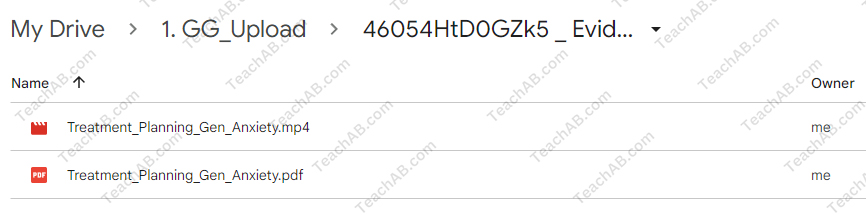
Planning Treatment for Generalized Anxiety Disorder Using Evidence
Millions of people worldwide suffer with generalized anxiety disorder (GAD), a widespread illness that presents as a persistent state of concern and anxiety. The complex realm of evidence-based treatment planning for GAD is thoroughly examined in this engrossing lecture by Drs. Timothy Bruce and Arthur Jongsma. In addition to outlining the DSM’s primary symptoms and diagnostic standards, this extensive resource explores the treatment planning process, which may greatly enhance therapeutic results. The roughly 70-minute film is a wealth of information for mental health professionals looking to improve their methods in this difficult field of work.
The physicians skillfully craft a narrative that covers both the clinical and theoretical facets of treating GAD throughout the presentation. They establish a fundamental knowledge of the GAD treatment landscape by including historical viewpoints on empirically supported therapies (ESTs) in North American and European contexts. This educational flare blends well with real-world clinical scenarios and practical insights to provide an engaging learning environment for both new and seasoned practitioners. They offer a rigorous framework that is both effective and adaptable to many clinical contexts, with the ultimate goal of improving treatment efficacy.
A Comprehensive Overview of Generalized Anxiety Disorder
Definitions and Symptoms of GAD
Excessive concern over a wide range of topics is often a hallmark of generalized anxiety disorder, which can have crippling effects on a person’s day-to-day functioning. The DSM-5 criteria list restlessness, exhaustion, trouble focusing, irritability, tense muscles, and irregular sleep as possible symptoms. These symptoms frequently throw a shadow over even the most basic pleasures, resembling an unrelenting storm cloud over a person’s daily life.
Diagnostic Criteria
The DSM outlines several core elements for diagnosing GAD, which include:
- Persistent and excessive anxiety occurring more days than not for at least six months.
- Difficulty in controlling the worry.
- The anxiety and worry are associated with three (or more) of the following symptoms:
- Restlessness or feeling keyed up.
- Being easily fatigued.
- Difficulty concentrating or mind going blank.
- Irritability.
- Muscle tension.
- Sleep disturbance (trouble falling or staying asleep, or restless sleep).
These criteria illustrate that GAD is not merely a fleeting feeling of anxiety; it transforms into a chronic condition that affects an individual’s ability to function effectively. The overarching importance of timely diagnosis is emphasized, as misconceptions often lead to delayed treatment and exacerbation of symptoms.
Obstacles in the Therapeutic Partnership
For therapists, navigating the complexities of GAD poses special difficulties. A therapist’s experience is sometimes likened to a sailor navigating heavy seas, trying to stay on course while navigating the client’s ongoing worry. Since clients often show increased resistance and cynicism regarding therapy, it becomes crucial to maintain a strong therapeutic connection. The therapeutic alliance is the cornerstone of successful therapy, as Drs. Bruce and Jongsma emphasize the significance of building empathy and trust.
Methods of Treatment Based on Evidence
Overview of Empirically Supported Treatments Throughout History
A long history of research aimed at creating successful therapies for GAD has led to the development of empirically supported treatments, or ESTs. The lecture claims that both the European and North American models have offered insightful viewpoints. For example, one important first-line treatment is cognitive behavioral therapy (CBT). A key component of evidence-based practice, cognitive behavioral therapy (CBT) has been shown to be effective in reducing symptoms of generalized anxiety disorder (GAD), according to research by Hofmann et al. (2012).
Furthermore, pharmaceutical interventions such selective serotonin reuptake inhibitors (SSRIs) have shown promise, especially for those without access to psychological therapy. To successfully incorporate these treatments into their practices, practitioners must be up to date on the most recent research.
A Six-Step Treatment Planning Process
Dr. Bruce and Dr. Jongsma have crafted an adaptable six-step treatment planning process that empowers mental health practitioners to design individualized interventions grounded in empirical evidence. This structured framework serves as a roadmap, guiding clinicians through comprehensive treatment planning:
- Assessment – Gather comprehensive data, assessing both psychological and physical parameters.
- Diagnosis – Utilize validated tools to confirm the GAD diagnosis based on DSM criteria.
- Goal Setting – Establish measurable and attainable treatment goals in collaboration with the client.
- Intervention Selection – Choose appropriate therapeutic modalities based on client needs and preferences.
- Implementation – Execute the treatment plan while continuously monitoring the therapeutic alliance.
- Evaluation – Regularly assess progress and make necessary adjustments to the treatment protocol.
By systematically applying this six-step process, clinicians can enhance the tailoring of interventions, making them more responsive to the unique needs of each client.
Real-World Examples of Interventions Illustrated
Live clinical vignettes showcasing certain therapies like cognitive restructuring and relaxation training are incorporated into the presentation. Theory and practice are crucially connected by these demonstrations. For instance, relaxation training gives customers a practical way to lessen acute anxiety symptoms; it’s sometimes compared to taking a deep breath of fresh air. Conversely, cognitive restructuring encourages clients to question illogical beliefs, which promotes a change to more practical and flexible thought processes.
Techniques for Preventing Relapses
Additionally, incorporating relapse prevention techniques gives therapists a comprehensive arsenal to assist clients during their therapeutic process. By assisting clients to identify possible triggers and create coping mechanisms, these tactics place an emphasis on taking a proactive approach.
Key relapse prevention techniques include:
- Cognitive Self-Monitoring: Fostering self-awareness around thought patterns.
- Scheduled Worry Times: Allocating specific times to address worries as a means to contain anxiety.
- Developing Coping Plans: Formulating actionable strategies for stress-inducing situations.
By instilling these techniques, therapists empower clients to navigate their mental health challenges with greater confidence.
Conclusion: The Path Ahead
Drs. Bruce and Jongsma’s observations provide a comforting basis for mental health professionals who want to improve their approaches to treating GAD. Their presentation offers an evidence-based framework that adjusts to the varied and nuanced nature of the therapeutic interaction while still meeting established parameters. It’s not easy to navigate the harsh seas of anxiety, but with the correct resources and knowledge, physicians may help their patients develop resilience and undergo significant change. For mental health practitioners committed to providing high-quality care based on the most recent research and clinical best practices, the information presented in this video serves as a ray of hope and direction as the path to successful treatment continues to change.
Frequently Asked Questions:
Business Model Innovation:
Embrace the concept of a legitimate business! Our strategy revolves around organizing group buys where participants collectively share the costs. The pooled funds are used to purchase popular courses, which we then offer to individuals with limited financial resources. While the authors of these courses might have concerns, our clients appreciate the affordability and accessibility we provide.
The Legal Landscape:
The legality of our activities is a gray area. Although we don’t have explicit permission from the course authors to resell the material, there’s a technical nuance involved. The course authors did not outline specific restrictions on resale when the courses were purchased. This legal nuance presents both an opportunity for us and a benefit for those seeking affordable access.
Quality Assurance: Addressing the Core Issue
When it comes to quality, purchasing a course directly from the sale page ensures that all materials and resources are identical to those obtained through traditional channels.
However, we set ourselves apart by offering more than just personal research and resale. It’s important to understand that we are not the official providers of these courses, which means that certain premium services are not included in our offering:
- There are no scheduled coaching calls or sessions with the author.
- Access to the author’s private Facebook group or web portal is not available.
- Membership in the author’s private forum is not included.
- There is no direct email support from the author or their team.
We operate independently with the aim of making courses more affordable by excluding the additional services offered through official channels. We greatly appreciate your understanding of our unique approach.
Be the first to review “Evidence-Based Treatment Planning for Generalized Anxiety Disorder with Timothy Bruce & Arthur Jongsma”
You must be logged in to post a review.
Related products
Psychology
IFS & The Treatment of Addictions: Biology, Healing and Habits with Frank Anderson – PESI
Original price was: 59,00 $.15,00 $Current price is: 15,00 $.

Original price was: 39,00 $.8,00 $Current price is: 8,00 $.

Original price was: 39,00 $.8,00 $Current price is: 8,00 $.


Original price was: 39,00 $.8,00 $Current price is: 8,00 $.


Reviews
There are no reviews yet.